Run the wholeaudition day.Prove it was fair.
Applications, prescreens, a seeded draw anyone can verify, candidate numbers, QR check-in, a blind jury tablet, round advancement, and one export that answers every fairness question — in a single system.
14-day money-back guarantee (unused service — see Terms) No auto-renewal — we remind you Musician accounts free forever
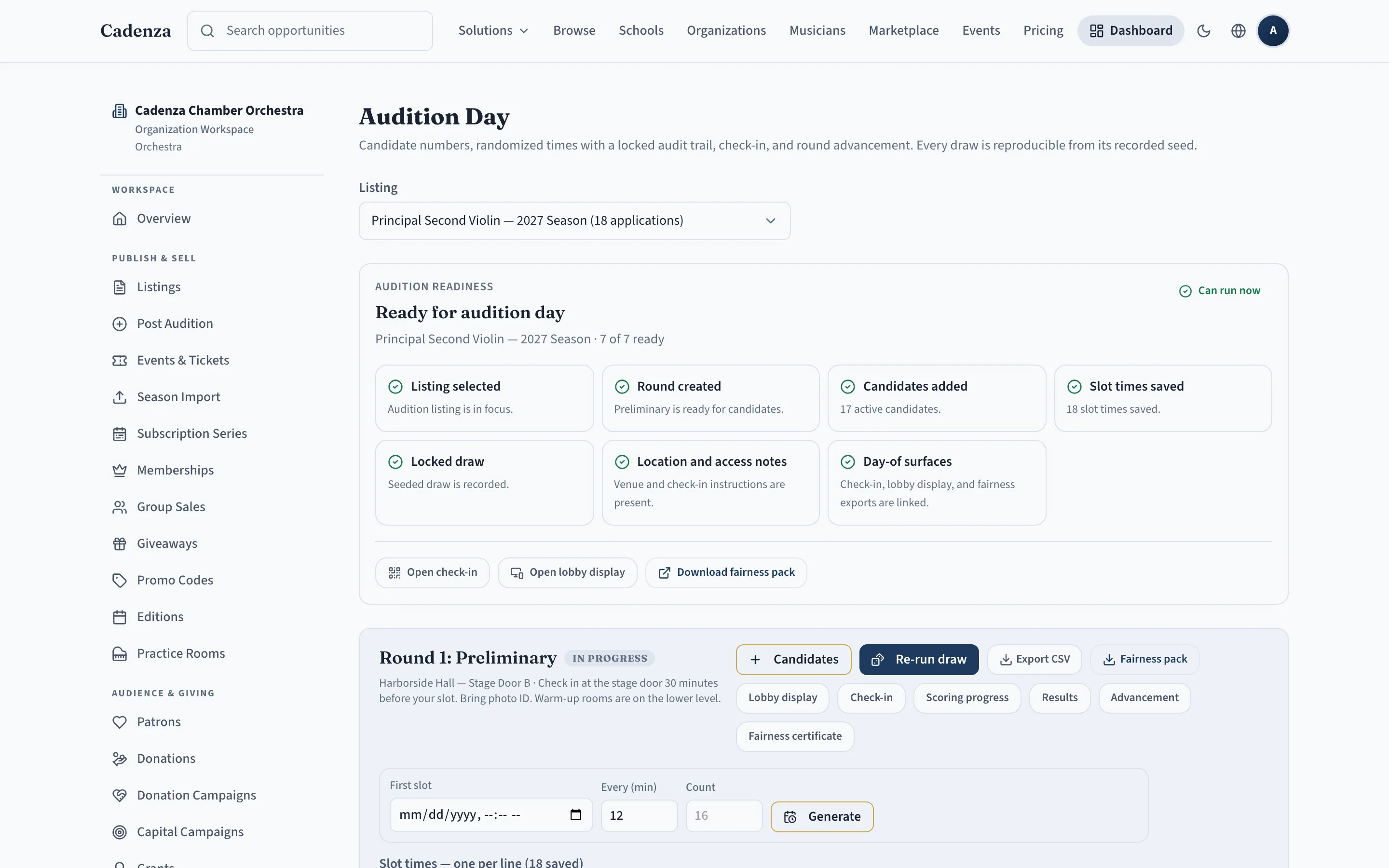
The audition-day cockpit — a real round, not a mockup: readiness checks, the locked seeded draw, and every day-of surface one click away.
Built for the whole classical & jazz audition world
Lobby display
The waiting room stops asking the front desk.
Put it on the monitor by the door. It calls audition numbers only — never a name — and refreshes itself, so the corridor knows who is on next without anyone leaking who is in the room. Every screenshot in this tour is a real Cadenza audition round, not a mockup.
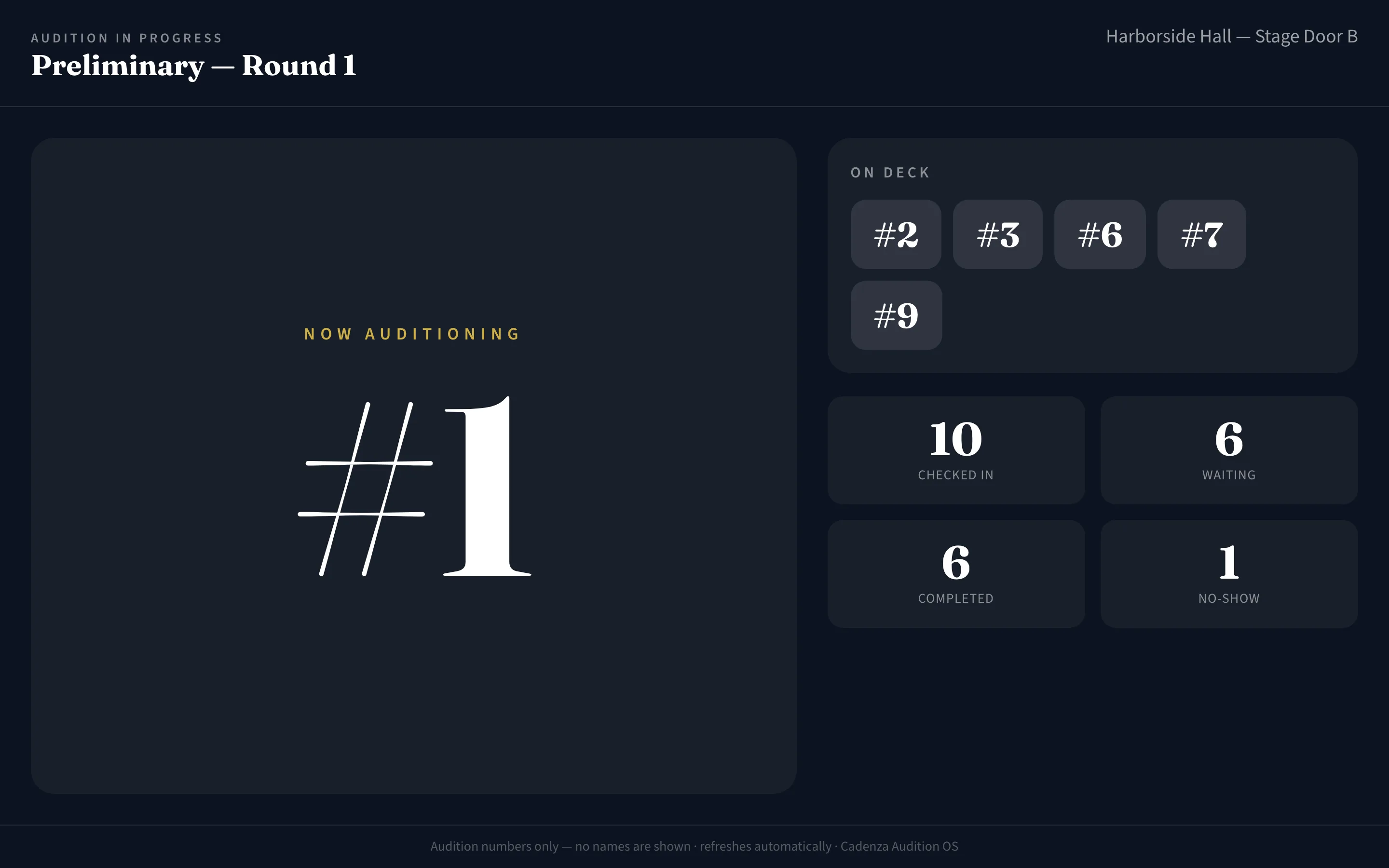
Numbers only. No names appear on this screen at any point in the round.
Jury tablet
A panel that never sees a name.
Hand each juror an iPad. They see an audition number, the program, and your weighted criteria — one candidate at a time. Identity is stripped server-side, so it cannot leak to the panel even if someone goes looking.
- Blind by audition number, enforced at the API
- Your own criteria and weights
- One-tap comment chips instead of tablet typing
- Self-recusal when a juror knows a candidate
- Scores queue offline and sync when the room’s wifi returns
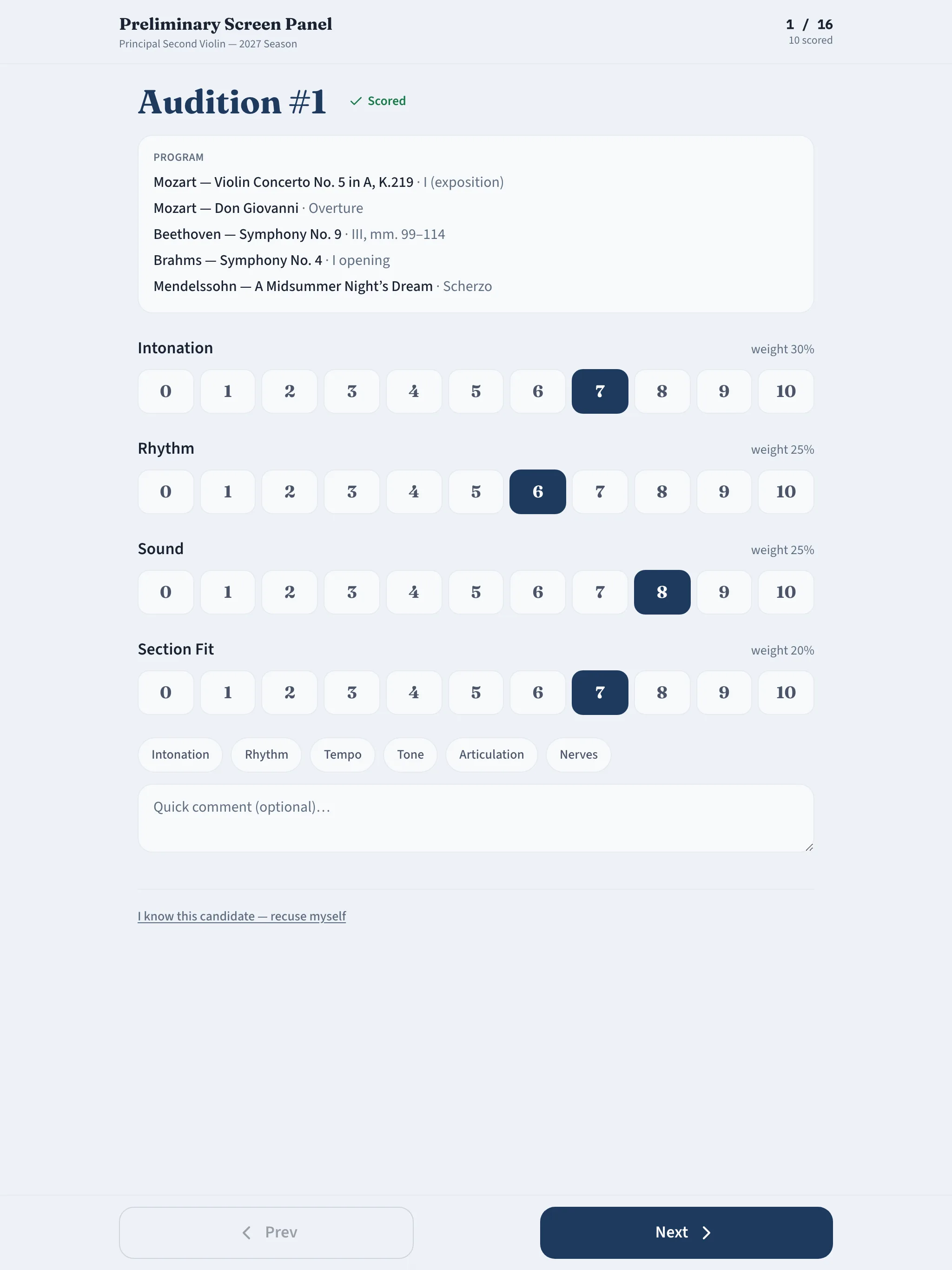
Tablet scoring — the candidate is “Audition #1”, and that is all the panel is ever given.
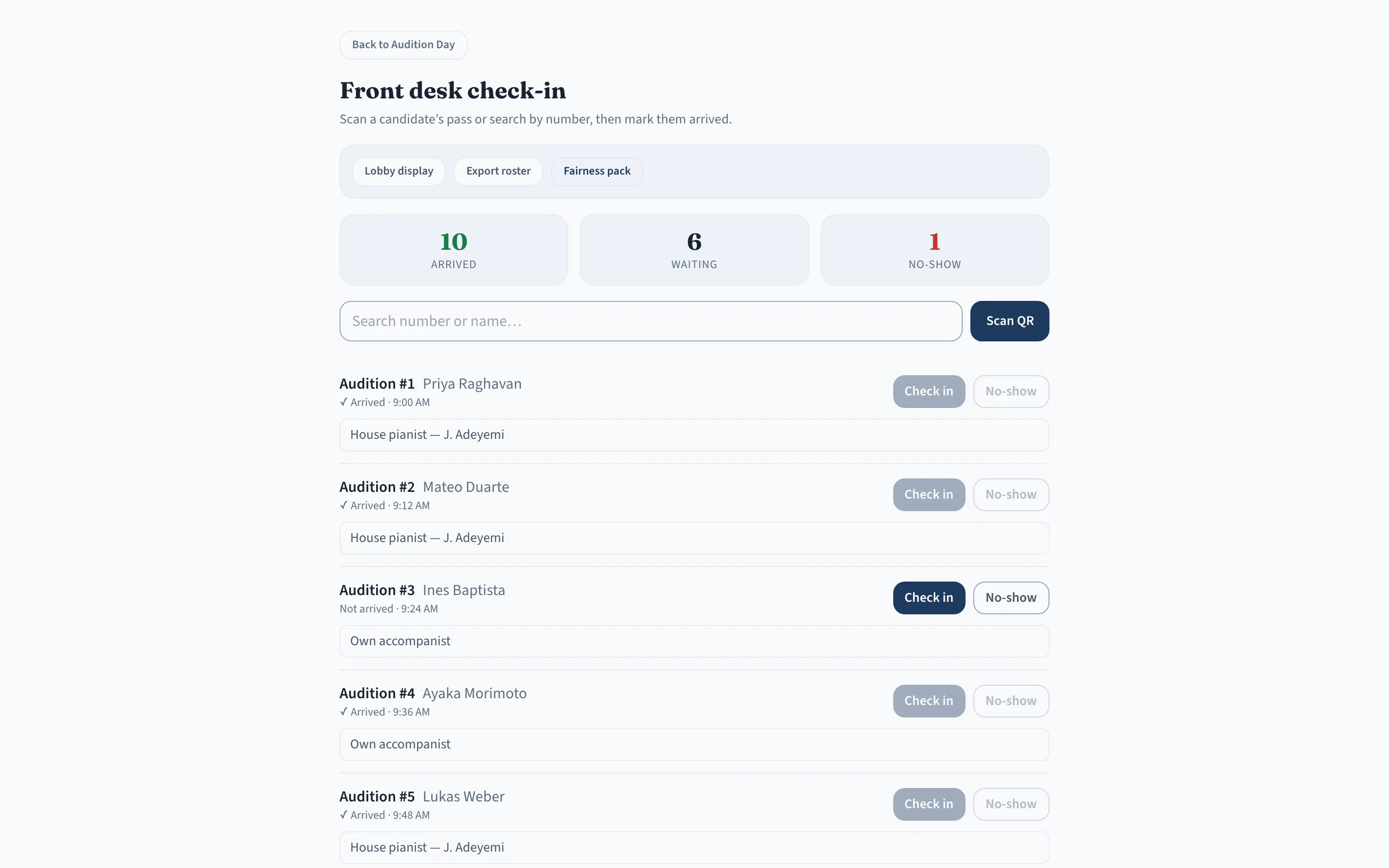
Front desk
Check candidates in without a clipboard.
Scan the candidate’s QR pass or search by number. Arrival is written once and timestamped, so a double-scan is harmless and the record can’t be quietly rewritten later.
- QR pass scan or search by number
- Arrived, no-show, and withdrawn in one tap
- House pianist and accompanist notes on the row
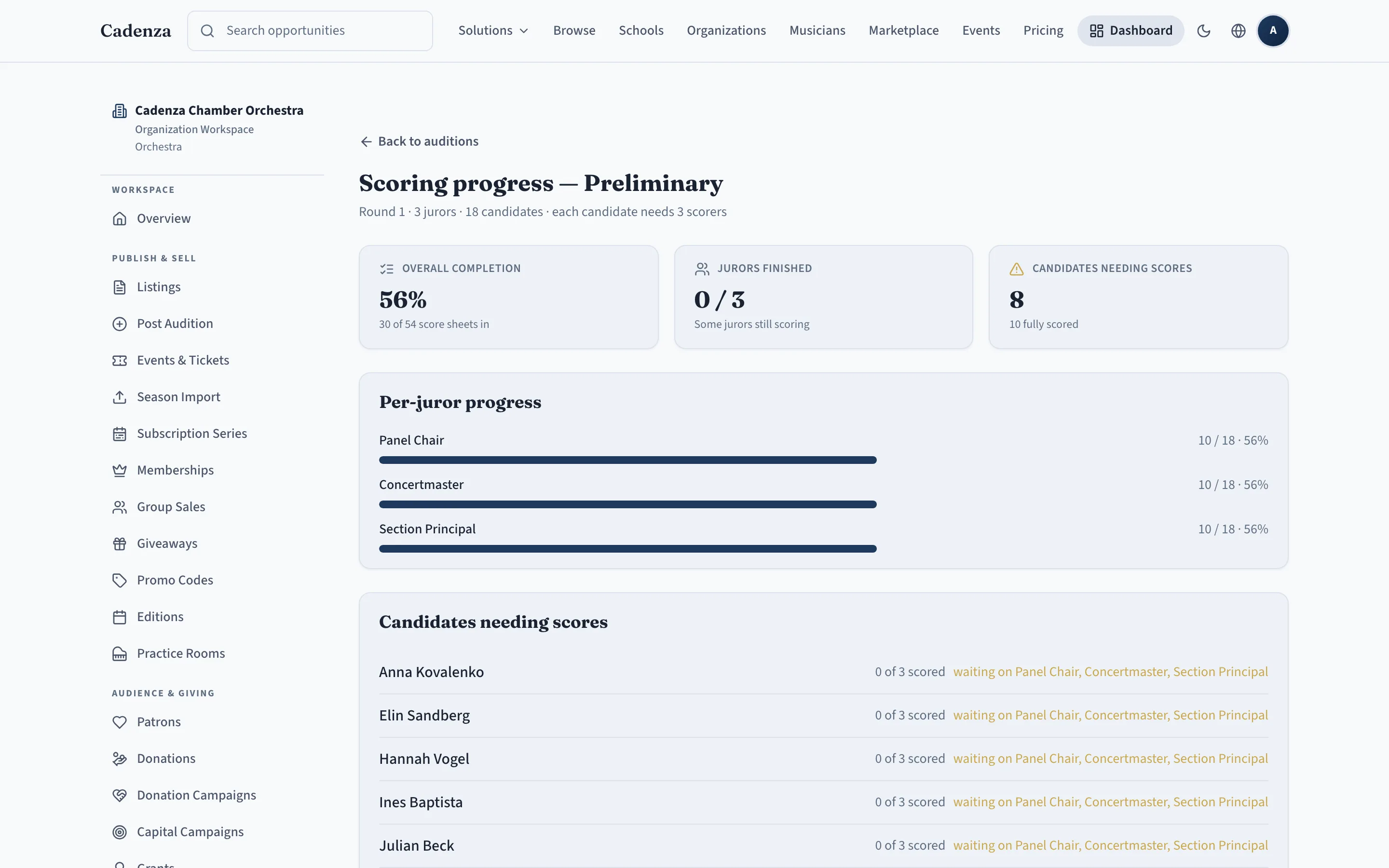
Scoring progress
Know who still owes you a score — before the panel convenes.
Other tools show you the scores. They don’t show you the gaps. Cadenza tracks per-juror completion and lists exactly which candidates are short of the panel’s required number of marks, and who you’re waiting on.
- Per-juror completion bars
- Ranked worklist of candidates needing scores
- Names the specific jurors you’re waiting on
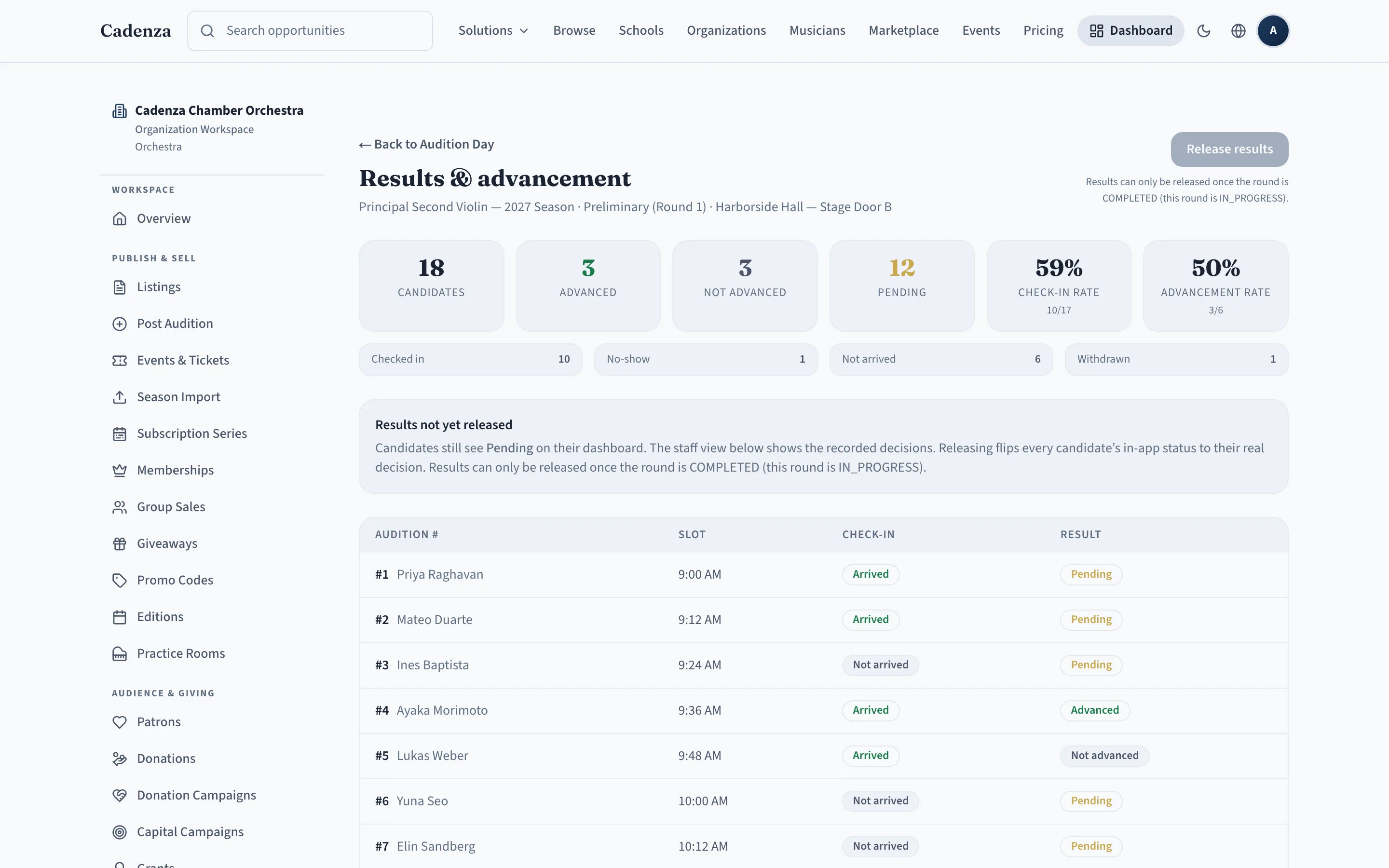
Results & advancement
Record every decision, release them when you’re ready.
Advance or not-advance each candidate against a full audit trail. Candidates keep seeing Pending until you explicitly release — so nobody learns their result from a bug.
- Check-in rate and advancement rate at a glance
- Results stay private until explicitly released
- Every state change kept in an exportable log
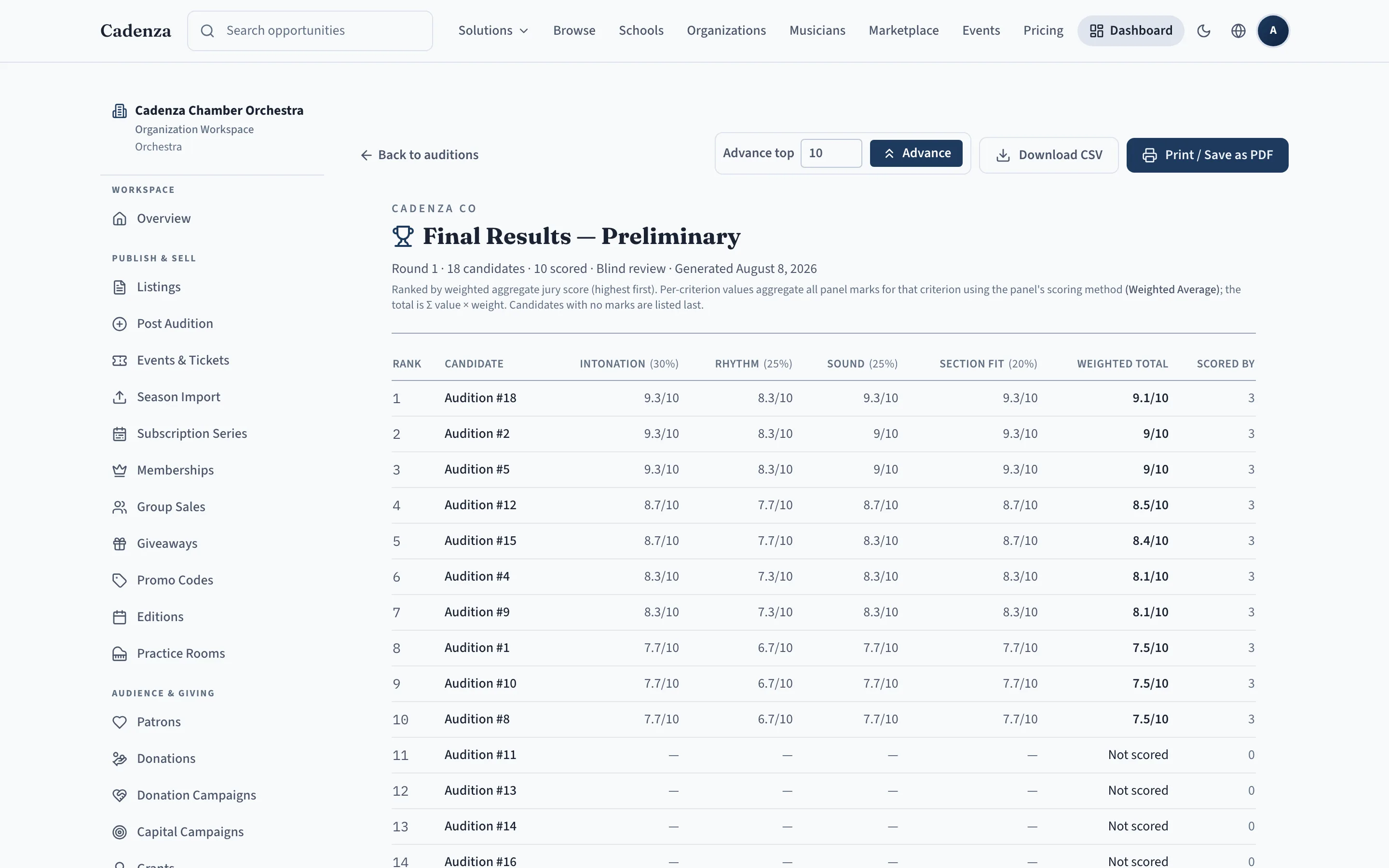
The committee meeting
A ranked list that is still blind.
Weighted aggregate by audition number, with the arithmetic shown. Advance the top N in one action, or export the whole thing to CSV or PDF for the file.
Run your next audition on this.
Claim your organization free, then unlock the audition workflow when your cycle opens.
The audition lifecycle, end to end
One platform from the first application to the exported fairness pack — no exports to a second system in between.
Before
Open the cycle
- Post the opening or admissions cycle with requirements, deadlines, and fees
- Receive applications on a branded in-platform form — no second system
- Collect repertoire, media, transcripts, and confidential recommendations
- Prescreen the submitted media and advance or eliminate — blind, if you choose
Setting up
Build the day
- Invite advanced applicants into an audition round
- Publish slot windows; candidates self-schedule without double-booking
- Lock a seeded random draw that anyone can reproduce from the seed
- Issue stable candidate numbers plus per-round blind audition numbers
On the day
Run the room
- Check candidates in by QR or number, with a write-once arrival record
- Call numbers on a lobby display that never shows a name
- Score blind on the jury tablet against your weighted criteria
- Chase the missing marks with per-juror scoring progress
After
Decide and prove it
- Record advance / not-advance with a full audit trail
- Carry advanced candidates forward; re-draw and re-number as needed
- Admit, reject, waitlist, send offers, capture accept and decline
- Export the fairness pack: register, draw verification, log, scores, decisions
Why a result holds up
Fairness you can hand to a union rep.
Every guarantee below is enforced by the software, not promised in a policy document. That is the difference between believing an audition was fair and being able to show it.
Blind is enforced server-side
When a panel is blind, identity is stripped at the API layer — not hidden in the interface. The panel cannot see a name even by looking for one.
The draw is reproducible
Playing order comes from a recorded seed, and anyone can regenerate the exact order from it. A re-run never overwrites history — it supersedes it, and records who re-ran it and why.
Arrival is written once
The front desk stamps arrival a single time. A double-scan is harmless, and the arrival evidence cannot be quietly rewritten after the fact.
Jurors can recuse themselves
A juror who recognises a candidate taps recuse. The rubric locks and any prior marks on that row are voided out of every aggregate.
Results release on your word
Candidates see Pending until the round is complete and you explicitly release. Nobody learns their outcome from a refresh.
One export answers the challenge
The fairness pack assembles the candidate register, the draw seed and verification, the check-in log, the scores, and the decisions — for HR, the board, faculty, or a union.
The alternative
One more season on spreadsheets is a bet.
Every audition you run without records is a result you may one day have to defend from memory. These are the moments that decide it:
A candidate challenges the order
“Why did I play last, cold, at 6pm?” With a spreadsheet, your answer is “we shuffled it.” With Cadenza, it's a seed anyone can re-run and verify — recorded before the first note.
A union rep asks for the file
A grievance lands months later. Whose notes survive? The fairness pack — register, draw, check-in log, scores, decisions — is one export, not a week of reconstructing emails.
A juror saw a name they knew
Paper ballots can't un-see a résumé. Cadenza strips identity at the API and records recusals — so “was it really blind?” has a provable answer instead of an awkward pause.
Your next cycle is closer than it looks — applications open months before audition day, and the draw must be locked before schedules go out.
Set up before the season opensLive in the product today
Application packets
In-platform applications with repertoire, media, transcripts, and custom questions.
Self-scheduling
Candidates pick an available slot; double-booking is prevented at the seat level.
Candidate & audition numbers
Stable candidate numbers plus per-round blind audition numbers.
QR check-in
Candidates carry a QR audition pass; the front desk scans it or searches by number.
Lobby display
A privacy-safe waiting-room screen showing now-auditioning and on-deck by number.
Jury tablet scoring
Touch-first, one candidate at a time, offline-tolerant, blind by number.
Scoring progress
Per-juror completion and a worklist of candidates still short of marks.
Fairness pack export
Candidate register, draw seed and verification, and the full state-change log.
Institution-ready operations
Built for a real audition office.
Audition OS is organized around the people who have to make the day work: the manager, front desk, jury chair, and lobby team. Every role gets a focused surface instead of another spreadsheet.
Audition manager
One cockpit for listings, rounds, candidates, slots, the locked draw, advancement, result emails, and exports.
Front desk
A dedicated check-in roster for arrivals, no-shows, withdrawals, accompanist notes, and candidate pass lookups.
Jury chair
Tablet scoring by audition number with criteria, comments, autosave, and a clean path through each candidate.
Lobby team
A privacy-safe display that calls numbers only, with now-auditioning, on-deck, and room-status counts.
Launch checklist
The path from claimed org to a running audition day is explicit and auditable.
- 1Claim the organization and accept the auditions manager seat
- 2Select the audition listing and create the preliminary round
- 3Add eligible applicants as numbered candidates
- 4Save venue wall-clock slot times and access notes
- 5Lock the seeded draw and send candidate schedules
- 6Open check-in, lobby display, jury tablet, and fairness exports
Where Cadenza wins
The only platform that runs admissions, orchestra, opera, ballet, and festival auditions — and the box office and donor rails around them.
| Capability | Cadenza | Acceptd | YAP Tracker | Musical Chairs |
|---|---|---|---|---|
| Applications & packets | ✓ | ✓ | ✓ | ✓ |
| Prescreen review | ✓ | ✓ | ~ | ✓ |
| Applicant self-scheduling | ✓ | ✓ | ✕ | ~ |
| Jury scoring | ✓ | ✓ | ~ | ~ |
| Candidate / audition numbers | ✓ | ~ | ✕ | ✓ |
| Provably-fair random draw | ✓ | ✕ | ✕ | ✕ |
| Round advancement | ✓ | ~ | ✕ | ✕ |
| School admissions auditions | ✓ | ✓ | ✕ | ✕ |
| Orchestra auditions | ✓ | ✕ | ~ | ~ |
| Opera / ballet / festival | ✓ | ~ | ✓ | ~ |
| Ticketing & donations | ✓ | ✕ | ✕ | ✕ |
| One musician profile across all | ✓ | ✕ | ~ | ~ |
✓ first-class · ~ partial · ✕ not the focus. Competitor coverage verified against each vendor's own public pages 2026-08-14 (incl. musicalchairs.info/help/ats) and may change.
Pricing
Audition Day Pass
$299 one-time · 60 days
Run one full audition cycle without a subscription — applications, prescreening, the blind draw, candidate numbering, check-in, rounds, and jury scoring. The on-ramp below the annual plan.
Run one complete audition for $299Festival Admissions Pro
$12,000 per year
For festivals that need stronger automation across applications, reminders, reviewer workflows, jury scoring, status notifications, CSV transition support, webhooks, and launch operations.
Talk to usFull-service audition operations
From $18,000 per year
Cadenza helps configure the cycle, transition dry-run, reviewer setup, communications, automation queues, and launch operations when a buyer wants concierge support. Concierge onboarding is hands-on — we configure the cycle with your team, not from a template.
Plan the seasonWhat the $299 Audition Day Pass covers
Included: one organization's complete audition workflow — in-platform applications, prescreening, blind review, candidate numbering and draw, scheduling and check-in, rounds, jury scoring, decisions, and offers.
Not included: the pass does not include a job or listing credit. Cadenza charges no per-applicant fee; if your organization charges applicants, you set, collect, and disclose that fee separately.
Timing: the pass starts on confirmed payment, lasts 60 days, and has no automatic renewal. When it ends, paid audition actions are locked; organization records are not deleted simply because the pass expires.
Support and refunds: email hello@cadenza.work for setup or product help. A 14-day money-back guarantee applies only before the paid audition workflow has been materially used; see Terms.
Full-Service Audition Operations (from $18,000/yr): Cadenza helps configure and run your audition cycle.
Audition OS questions
- Can a school run admissions auditions end to end?
- Yes. Application builder, repertoire and media upload, confidential recommendations, application fees and waivers, faculty scoring, decisions, and offer letters with accept/decline are all in the product today.
- Can an orchestra run a real audition day?
- Yes. Candidate and audition numbers, a seeded random draw you can independently verify, front-desk check-in, blind jury scoring by number, and round advancement — with a complete audit trail you can export.
- What makes the random draw trustworthy?
- The draw is generated from a recorded seed and is re-verifiable: anyone can reproduce the exact order from the seed. Re-runs never overwrite history — they supersede the prior draw and record who re-ran it and why.
- Is the jury really blind?
- When a panel is set to blind review, jurors only ever see a candidate number. Identity is stripped at the API layer, not just hidden in the UI, so it can never leak to the panel.
- What happens if the wifi drops in the hall?
- The jury tablet queues scores locally and syncs them when the connection returns, so a dead spot in the building does not cost you a juror’s marks.
- How is this priced?
- The $299 / 60-day Audition Day Pass is a one-time payment for one organization’s audition workflow: applications, prescreening, blind review, the draw, check-in, rounds, jury scoring, decisions, and offers. It does not include a listing credit or applicant fees, and it never auto-renews. Festivals running a full admissions season use Festival Admissions Pro at $12,000/yr; selected festivals may qualify for a private implementation pilot before the season. Full-service operations are available when Cadenza should help configure and run the season.
- What happens when the 60-day pass ends?
- The pass starts when payment is confirmed and ends 60 days later. It does not renew or charge again. The paid audition workflow is no longer unlocked after expiry, but Cadenza does not delete your organization records because the pass ends. Export any material you need while you have access.
- Can I get help or request a refund?
- Email hello@cadenza.work for setup or product help. The Day Pass has a 14-day money-back guarantee only while the paid audition workflow has not been materially used; see the Terms for the full refund process and exceptions.
Make your next audition the easy one.
Start a one-off audition with the $299 Audition Day Pass, or run the whole festival admissions season on Festival Admissions Pro.
Applications open months before audition day. The orgs that set up now are the ones whose candidates self-schedule instead of emailing.
Not sure where you stand? Grade your current process — free →