The most sought-after trumpet in America was built by a refugee who arrived with $5. Today his company is owned by a hedge fund billionaire who's closing the last factory and shipping the jobs to China.
If you play a Bach trumpet, a Conn French horn, a Selmer saxophone, or Ludwig drums — you might want to know who owns the company behind them.
The Horn Guys — a respected brass instrument specialty dealer in Pasadena, California — recently posted a breakdown on Facebook that caught fire across musician communities. The connection: Conn-Selmer, Inc., the company behind most of America's school band and professional brass instruments, is ultimately owned by John Paulson, a billionaire hedge fund manager and one of the largest political donors in the country. The post was tied to "No Kings Day 3" — the largest protest movement against the second Trump administration, which drew an estimated 8–9 million protesters on March 28, 2026, the largest single-day protest in American history.
The message was direct: buying a new Bach, Conn, King, or Selmer instrument puts money into Paulson's empire. Musicians started sharing it. Calls for a boycott followed.
But to understand what's actually at stake, you need to understand what these brands represent — and that story starts with a refugee, a broken mouthpiece, and a $300 lathe.
The Man Who Built Bach
Vincenz Heinrich Schrottenbach was born March 24, 1890, in Baden bei Wien, Austria. His father died in a bicycle accident when Vincenz was seven. He received his first trumpet the same year.
By 14, he was studying under Georg Stellwagen, principal trumpet of the Vienna Tonkünstler Orchestra — one of the greatest trumpet virtuosos in Europe. He also graduated from engineering school in 1910: the ear of a musician and the precision of an engineer.
When World War I broke out, Schrottenbach was performing in England. Facing internment as an enemy alien, he fled to America, arriving in New York on September 18, 1914, aboard the RMS Lusitania — the same ship a German U-boat would sink seven months later, killing 1,198 people. He arrived with reportedly $5 in his pocket and Americanized his name to Vincent Bach.
A letter of introduction to conductor Karl Muck earned him an audition with the Boston Symphony Orchestra. Within a year, he was first trumpet at the Metropolitan Opera. He served in the U.S. Army in 1917 as Sergeant Bugler at Camp Upton and was honorably discharged in 1918.
Then came the moment that changed American music. While on tour in Pittsburgh, a repairman convinced Bach he could improve his mouthpiece — and destroyed it. Bach couldn't find a replacement that met his standards. So in 1918, with a $300 foot-operated lathe, he started making his own in a rented room in Manhattan.
By 1920: 12 mouthpieces a day. By 1922: the Vincent Bach Corporation, 10 employees. By 1924: his first trumpet. Musicians who played them started calling them "a real Stradivarius." Bach adopted the name.
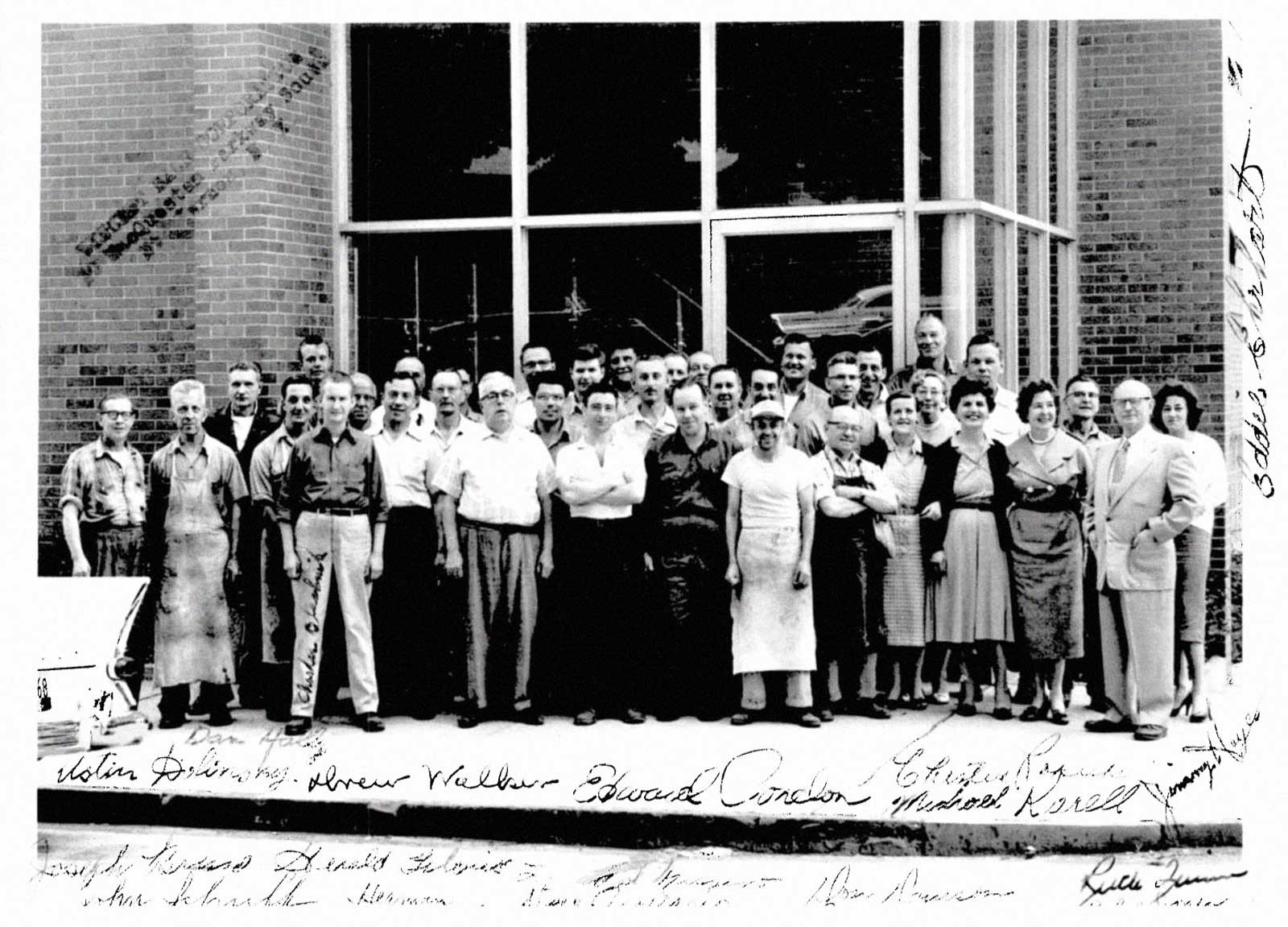
In 1928, he added trombones and moved to a larger factory in the Bronx — 40 workers hand-building instruments under his direct supervision. In 1953, he built his dream: a purpose-designed factory at 50 South MacQuesten Parkway in Mount Vernon, New York. He specified every detail of the building himself. The instruments produced there between 1953 and 1965 are considered the finest brass instruments ever made in America.
Annual production at Mount Vernon: roughly 3,000 horns a year. Each one hand-assembled. Each one inspected by Bach or his closest associates. Revenue in the mid-1950s: approximately $250,000 — modest by any standard, built on quality over volume.
Today, Mount Vernon Bachs sell for $3,000–$6,000+ on the used market — routinely commanding higher prices than brand-new instruments. Sixty-year-old trumpets worth more than what the factory produces now.
In 1961, at 71, Bach sold his company to H. & A. Selmer for $750,000 — about $8 million today. He received 14 bids and chose Selmer — not the highest offer — because he trusted them to maintain quality. He stayed on as consultant until his death on January 8, 1976.
And his instruments defined what American orchestral brass would sound like for the next century.
Adolph "Bud" Herseth played a Bach trumpet as principal of the Chicago Symphony Orchestra for 53 consecutive years — from 1948 to 2001 — the longest tenure of any principal player in CSO history. He performed under Bruno Walter, George Szell, Leonard Bernstein, Fritz Reiner, Georg Solti, and Daniel Barenboim. The sound he produced — powerful, precise, brilliant — became known worldwide as "the Chicago sound." A uniquely American style of playing, built on an instrument made by a man who'd arrived with $5.
In 1955, Fritz Reiner personally directed the purchase of custom Bach Stradivarius C trumpets for the CSO — the first Stradivarius trumpets in C ever produced. They remain in the orchestra's collection today.
The Conn 8D French horn became the instrument of choice for the Cleveland Orchestra, the Philadelphia Orchestra, the New York Philharmonic, and virtually every recording session in Los Angeles. It is the most recorded French horn in history. Most professionals still playing 8Ds are playing vintage Eastlake-era instruments — the same factory that's closing in June.
There is a photo, taken in the late 1960s, of Vincent Bach meeting Dizzy Gillespie in New York. The Austrian refugee who played first trumpet at the Met, sitting with the man who bent the bell of his horn upward and reinvented jazz. Two completely different worlds, connected by brass.
That's what this brand used to mean.
How One Man's Legacy Became a $512 Million Acquisition
After Bach's sale to Selmer, the corporate history of American band instruments became a story of consolidation. Selmer moved production to Elkhart, Indiana by 1965. The Mount Vernon factory was closed. Production scaled from 3,000 to 16,000–20,000 horns a year.
The timeline:
- 1961: Selmer acquires Vincent Bach Corporation
- 1965: Ludwig Drums acquires Musser Mallet Company
- 1981: Selmer acquires Ludwig-Musser
- 1985: C.G. Conn, King, Armstrong, and Scherl & Roth merge into United Musical Instruments (UMI)
- 2000: Steinway Musical Instruments acquires UMI for ~$85 million
- 2003: UMI and Selmer merge to form Conn-Selmer, Inc.
- 2004: Conn-Selmer acquires Leblanc Corporation (including Holton) for $36 million
By 2004, the brands that once represented dozens of independent workshops across America all belonged to one entity in Elkhart, Indiana. Elkhart — where C.G. Conn built the world's largest instrument factory by 1905, where by the 1970s 40% of all band instruments in the world were made. The "Band Instrument Capital of the World." An entire American city built its identity on building instruments.
The full roster under one roof:
| Brand | Instruments | Founded | Origin Story |
|---|---|---|---|
| Vincent Bach | Trumpets, trombones | 1918 | Austrian refugee's workshop in Manhattan |
| C.G. Conn | French horns, trombones | 1876 | Civil War veteran in Elkhart — world's largest instrument factory by 1905 |
| King | Trombones, tubas | 1893 | H.N. White Company, Cleveland — Tommy Dorsey's brand |
| Holton | French horns | 1898 | Frank Holton, principal trombone of the Sousa Band |
| Selmer (USA) | Saxophones, clarinets | 1904 | Alexandre Selmer brought French craftsmanship to New York |
| Armstrong | Flutes, clarinets | 1931 | C.G. Conn shop foreman struck out on his own |
| Leblanc | Clarinets | 1750 / 1946 | French lineage to the court of Louis XV |
| Ludwig | Drums, percussion | 1909 | Two brothers in Chicago — then Ringo Starr on Ed Sullivan, 1964 |
| Musser | Mallet percussion, vibes | 1948 | Marimba virtuoso who conducted 100 players at the 1933 World's Fair |
| Scherl & Roth | String instruments | 1932 | Seventh-generation German violin maker |
Today, Conn-Selmer's marketing boasts "over 750 years of combined heritage." Technically true — add up every brand's founding date. But those 750 years were built by dozens of independent companies. Now they're all controlled by one hedge fund.
Important distinction: The "Selmer" in Conn-Selmer refers to H. & A. Selmer USA. Henri Selmer Paris — the legendary French company behind the Mark VI saxophone — is a completely separate, independently owned company, acquired by French investment firm Argos-Wityu in 2018. If you own a Selmer Paris instrument, Paulson doesn't see a cent.
In 2013, John Paulson acquired the parent company — Steinway Musical Instruments Holdings — for approximately $512 million, bringing both Steinway & Sons pianos and Conn-Selmer under his control.
What Bach Actually Became
Here's the part the nostalgia crowd doesn't like to talk about: the Bach name has been living off its reputation for decades.
After Selmer moved production to Elkhart, output scaled 5–7x. The early Elkhart instruments used remaining Mount Vernon parts, so the first wave was nearly indistinguishable. But as those parts ran out, things changed.
Bell stock thickness was increased from 0.020" — the Mount Vernon standard — to 0.025". The original thinner stock, which gave those horns their resonance, was reclassified as "lightweight" and sold as a premium option. What used to be standard became the upgrade.
By the 2000s, quality control had become an industry-wide joke among serious players. Specialty dealers like Kessler & Sons began personally inspecting and hand-picking every Bach Stradivarius before selling — checking for structural, cosmetic, and assembly defects, then performing a vibration test because poorly assembled solder joints hinder the instrument's response. Horns that don't pass get sent back.
A third-party dealer has to quality-check every instrument from a company that's marketed itself on craftsmanship for over 100 years. That's not artisan manufacturing. That's a QC problem.
Documented issues with modern Bach instruments:
- Sloppy solder joints on leadpipes — poorly fitted, missed spots
- Valve slides too thin from excessive buffing
- Horn-to-horn variability — some excellent, many mediocre, some genuinely bad
- Quality collapse during the 2006 Elkhart strike, when production was temporarily outsourced
The market's verdict: vintage Mount Vernon Bachs sell for $3,000–$6,000+. New Bach Stradivarius trumpets retail for $3,000–$4,000. When 60-year-old instruments command higher prices than new ones, the trajectory is self-evident.
The China Problem
Conn-Selmer has been quietly outsourcing to Asia for years. The Bundy student line — respected, American-made, with the iconic Resonite clarinet that sold over a million units — was discontinued and replaced with instruments manufactured in Asia and relabeled "Selmer (USA)" and "Bach." Ludwig drums, Scherl & Roth strings, and other brands were moved to Chinese manufacturing. Heritage names, overseas factories.
In July 2024, Conn-Selmer signed a deal for a $21 million, 2-hectare production facility in Qidong, China — the Qidong Economic Development Zone, Jiangsu province. Official entity: Conn-Selmer Musical Instruments (Qidong) Co Ltd.
Workers at the Eastlake, Ohio plant were told the China factory would not affect their jobs. Six months later, those jobs were eliminated.
Professional French horns move to the non-union Elkhart facility. Tubas, sousaphones, student-grade horns — to Qidong. The company invested $21 million in China while claiming the American factory was losing $6 million a year.
That same Eastlake plant had been cited by OSHA for six amputation injuries in eight years, a worker injury rate four times the industry average, and $273,447 in penalties in January 2024 for repeat violations. The factory had real problems. The solution wasn't to fix them — it was to close the plant and move the work overseas.
The Financials
Steinway's 2022 IPO filing (later withdrawn) revealed the structure:
- Total net sales (2021): ~$538 million
- Steinway & Sons pianos: 75.5% of revenue — ~$406 million
- Conn-Selmer instruments: 24.5% — ~$132 million
Conn-Selmer — the largest band instrument manufacturer in the United States, ten historic brands, "750 years of heritage" — generates barely a quarter of the parent company's revenue. The pianos are the business. The instruments are the sideshow.
Current estimates: Conn-Selmer standalone revenue ~$299 million, but with Eastlake losing $6 million annually, margins are under pressure. The China factory and plant closure are cost cuts on what's already the smaller, less profitable division.
The Eastlake Closure
In January 2026, on the first day of contract negotiations with UAW Local 2359, Conn-Selmer announced it would close the Eastlake plant by June 30, 2026 — 150 union jobs eliminated.
This drew attention because Paulson had appeared on CNBC in September 2024 saying:
"We can't have American producers closing American factories and offshoring. We need to protect American jobs and protect American manufacturing."
He'd also hosted a Trump fundraiser in April 2024 that raised $50.5 million — the largest single political fundraiser in history at the time.
UAW Local 2359 President Robert Hines:
"To go publicly on CNBC to support the Trump administration's positive views on tariffs, and then you turn around and want to go send the work right over to China... it's a slap in our face."
The American Federation of Musicians called it "a betrayal of the union workers who built this brand's reputation." UAW President Shawn Fain sent a video message to the February 5 "Save Our Plant" rally in Eastlake.
Conn-Selmer's response: the closure would "improve our competitiveness" and the company remains "deeply committed to U.S. manufacturing."
The Steinway Hypocrisy
Here's something the boycott crowd ignores: Paulson doesn't just own Conn-Selmer. He owns Steinway & Sons — generating three times the revenue.
If you're boycotting Bach trumpets because of Paulson, you should logically boycott Steinway pianos too. Every conservatory practice room, every concert hall, every recording studio with a Steinway — that's Paulson's business.
But nobody's calling for a Steinway boycott. No pianist is posting "I'm selling my Model D." No music school is swapping their Steinways for Yamahas in protest. Because Steinways are expensive, hard to replace, and deeply embedded in institutional music.
Which is exactly the situation brass players are in with Bach and Conn — they just don't want to admit it.
What the Boycott Actually Means for Schools, Shops, and Working Musicians
Approximately 1.2 million students participate in high school marching band alone. Add middle school, elementary, concert bands, jazz bands, and orchestras — millions of American students playing instruments at any given time. The vast majority on Conn-Selmer products. The company claims 25% of the beginner market and 42% of the professional market.
For a band director outfitting 60–100 students on a public school budget:
- A Bach student trumpet (TR300H2): ~$1,500–$2,100
- A S.E. Shires Q Series (their most affordable): $3,515 — professional, not student
- A Getzen student trumpet (390/490 series): ~$1,500–$1,900
- A Yamaha student trumpet (YTR-2330): ~$1,600–$1,800
Yamaha and Getzen are the only realistic alternatives — and they're in the same price range, not cheaper. Switching brands at the student level isn't about saving money — it's about convincing a school purchasing department to change vendors for political reasons. Good luck with that.
There's also the repair problem nobody's discussing. Independent brass technicians depend on domestic parts supply chains. When manufacturing moves to Qidong, replacement parts change too. When Leblanc's Kenosha factory closed in 2007, technicians reported difficulty sourcing Holton parts for years. The same will happen with Conn and King brass components. Your existing instrument gets harder to maintain regardless of whether you buy anything new.
Band directors don't have the luxury of political shopping. They have purchase orders, school board approvals, and 12-year-olds who need a playable horn by September.
Put Your Money Where Your Mouth Is
Across Facebook groups, Reddit threads, and Twitter, musicians are declaring they'll "never buy Conn-Selmer again." Adding "No Kings" hashtags. And then going home to practice on their Bach Strad.
If a Conn-Selmer instrument sits in your house, you haven't boycotted anything. You've made a social media post.
So sell it.
Professional brass instruments hold their value remarkably well. A maintained Bach Strad, Conn 8D, or King 2B will find a buyer. Then buy from a company whose ownership you're comfortable with:
Trumpets — S.E. Shires (Hopedale, MA — employee-owned), Getzen (Elkhorn, WI — family-owned since 1939), Schilke (Chicago — independent since 1956), Yamaha, Adams (Netherlands)
French Horns — Alexander (Mainz — family-owned since 1782), Engelbert Schmid (Germany — family workshop), Paxman (London), Yamaha
Trombones — S.E. Shires (employee-owned), Edwards (Elkhorn, WI), Getzen (family-owned), Rath (UK), Yamaha
Saxophones & Clarinets — Yanagisawa (Tokyo — independent since 1893), Buffet Crampon (France — est. 1825), Yamaha, P. Mauriat
Drums & Percussion — DW (Oxnard, CA), Pearl, Yamaha, Majestic
Flutes — Powell (Waltham, MA), Muramatsu, Miyazawa, Yamaha
Some of these companies — Alexander, Buffet Crampon, Yanagisawa — have been in continuous family operation longer than the United States has existed. That's a boycott with teeth. A Facebook meme is not.
What Vincent Bach Would See Today
If he walked into Conn-Selmer headquarters in Elkhart today:
His name on instruments mass-produced at 16,000–20,000 units a year. A dealer network that hand-inspects his trumpets and rejects the bad ones before selling them. Solder blobs inside tubes. His bell stock thickness reclassified as a premium upgrade.
His name on student instruments manufactured in China.
His company owned by a man who has never played a note.
The Mount Vernon factory where his craftsmen hand-built 3,000 perfect horns a year? A parking lot.
The Eastlake plant where Conn horns were still made by union workers? Closing June 30. Jobs shipped to Qidong.
The marketing? "Over 750 years of combined heritage, craftsmanship, and innovation."
Vincent Bach built his company on one principle: never ship an instrument that wasn't worth playing. That principle died decades ago. The name just hasn't caught up yet.
The Bigger Picture
Ten brands. Dozens of closed factories — Mount Vernon, Kenosha, Elkhorn, Chicago, and now Eastlake. Student lines outsourced to Asia. Quality inconsistent enough that dealers hand-pick instruments before selling them. And on the other side: a growing market of independent, family-owned, and employee-owned makers who build fewer instruments, build them better, and answer to musicians instead of shareholders.
The Conn-Selmer boycott isn't really about John Paulson or Donald Trump. It's about whether the names on your instrument still mean what they used to mean.
If "No Kings" is just a hashtag you add between practice sessions on your Bach Strad, it doesn't mean anything. You're performing politics the same way you perform music — except nobody's paying you for this gig.
But if it means something real — if the ownership, the offshoring, and the declining quality genuinely bother you — then the path is simple:
Sell the horn. Buy from someone who builds instruments the way Vincent Bach did — with their own hands, in their own shop, with their name on the line. Move on.
That's a boycott. Everything else is a Facebook post.
The best response to corporate consolidation in music isn't a hashtag — it's building a career that doesn't depend on any single company. Browse open auditions at cadenza.work/browse/jobs. Competitions at cadenza.work/browse/competitions. Military bands at cadenza.work/browse/military. Schools and programs at cadenza.work/schools.
Instruments are tools. Your career is the thing that lasts.
Comments
Sign in to join the discussion.